

Insanity as a Defense
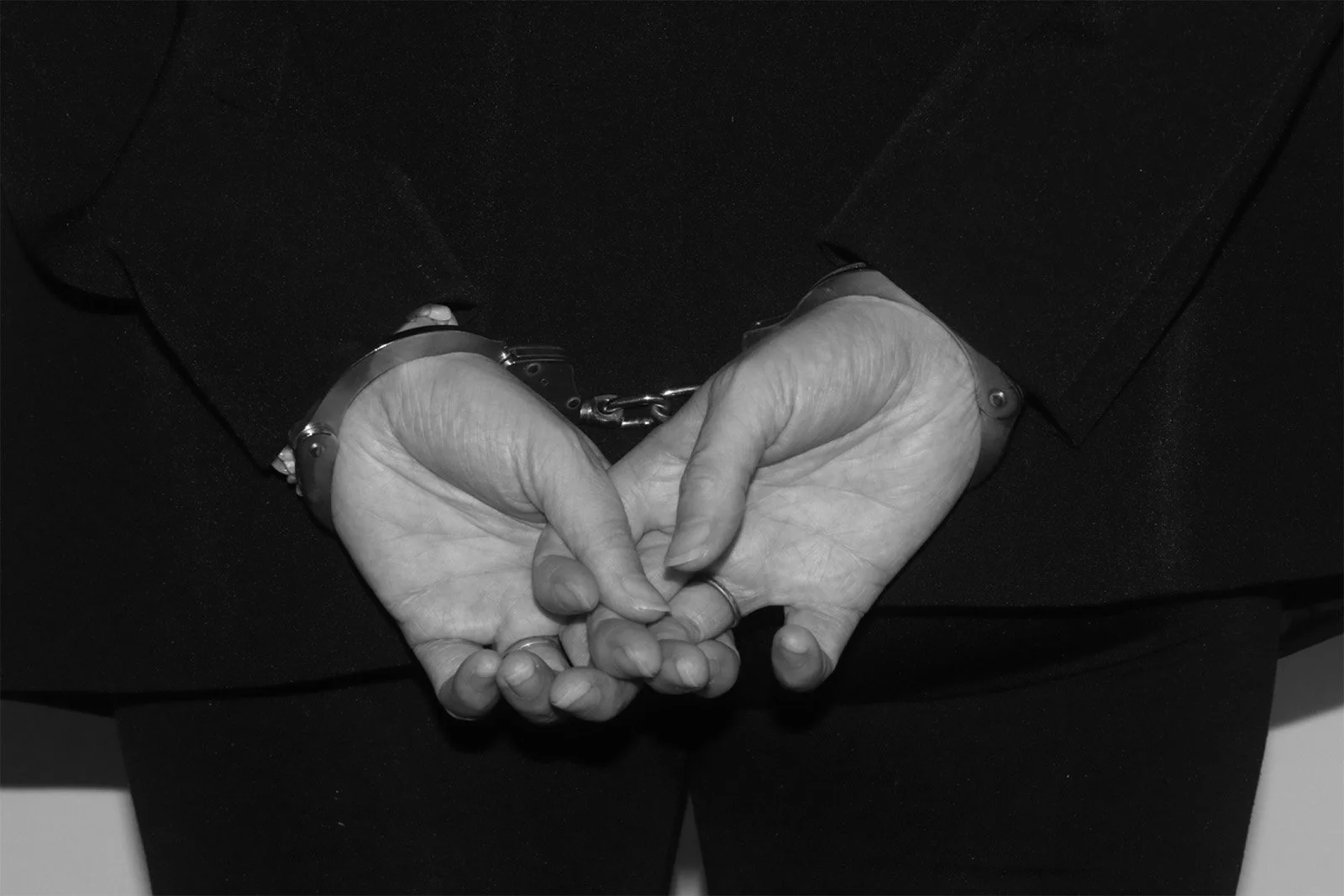
Photo from stock. Edited.
The police picked Sherry up after she stormed into the post office and demanded they stop tracking her. The postal workers tried to calm her down and asked her to leave. But their tolerance ran dry when she brandished a knife at them. The police knew Sherry – she didn’t have a permanent address, not even a P.O. Box, but everyone in her hometown of about 500 people knew her. They usually took her to her sister’s when she was found wandering around town, but this time they arrested her for carrying a weapon in a federal building.
Instead of booking her, though, they brought her to the mental health clinic where I worked. She shuffled in behind two young officers, hands cuffed behind her back, her shirt barely hanging onto her bony shoulders. She looked scared, glancing around occasionally from downturned eyes.
We called the county judge to commit Sherry. He could really have done so without looking at her, but he was a conscientious man and came to the clinic. Judge Bird was a tall, narrow man with angular features. He tipped his cowboy hat to me and then to Sherry.
“So, you went a little crazy, huh?” he asked her.
She met his eyes and grinned briefly.
He continued, “You know I have to send you somewhere now, Sherry? I hate to do it.”
“Yes, sir I know.”
The judge wanted to meet with our psychiatrist, too. Fortunately, it was Wednesday, the one day each week that the doctor held clinic in our center. While the two talked, the case worker took Sherry back to her office to complete the requisite hospitalization paperwork. The policemen who brought her slipped out.
Although people with mental health diagnoses are far more often the victims of violence than the perpetrators, the paranoia in paranoid schizophrenia can spur a belief among sufferers that they’re acting in self-defense, or at least that they’ve been provoked. Both Sherry and her brother had histories of this kind of violence. The procedure was for law enforcement to accompany her until she was safely locked up, either behind bars or on a secured psych unit.
As the director of the local community mental health center, I’d gotten to know Sherry and one of her brothers, whom they called Knock-Knock, particularly well. They both suffered from paranoid schizophrenia and that combined with childhoods full of physical abuse made for a potent mix when they stopped taking their antipsychotic medications. As a result, they were frequently the subject of crisis calls in the community with one agency or another hoping we’d handle “the situation.”
Our rural clinic had a total of four permanent personnel for about 800 seriously mentally ill adult clients and 300 children. Only three of us were authorized to do crisis intervention: the crisis worker/case manager, the nurse, and me. The nurse and I were also responsible for two other rural county’s clinics. Seldom could we afford someone to go to the scene in the community. It was a regular occurrence to find myself alone in this clinic with a new patient who’d come in for services.
The officers left because they knew the rules: either they or the sheriff’s office were responsible for transporting Sherry. The closest facility was a little over an hour away, but since Sherry had been taken into custody she would have to go to a facility for the “criminally insane.” At the time, there was only one in Texas that would take her because she’d been arrested for a violent crime. That meant a six- to seven-hour drive with Sherry in the back seat and another six or seven hours to return home. No one wanted to sign up for that.
I was manning the phones while the clinic secretary, who’d known Sherry since childhood, ate lunch. I rang the sheriff’s department and sat on hold, steeling myself for the fight we always got. “It’ll be after hours before we can come, ma’am. Can’t you take her?” Or “you might ought to call the police and see if they can help you, ma’am.” Sherry stared at me through the window that separated the waiting room from the front desk. She walked over and banged her head against the glass, rattling the entire flimsy set-up. I slid the window open, “What’s up, Sherry?”
“Where’s Jocelyn. You fire her?”
“She’s eating.”
“You know you gotta let me smoke.”
“All right.” I stalled. We weren’t supposed to leave the front office unmanned on clinic day.
“I gotta smoke. Before I get in with those agents y’all got coming.”
“You want to smoke now, then?” I hung up. I decided to instead ask the judge to get the Sheriff’s department to come get her.
“Yeah.” When she turned to survey the other people in the waiting room, I noticed a pink comb tucked into her short-cropped hair. She snorted and then turned back to me. “You got a cigarette?”
“I’m afraid not, Sherry.” I cringed inside. I smoked at the time and had a pack in my car, but I’d been warned against revealing any personal information to patients in the name of setting boundaries.
“Never mind.” She rocked on her heels while talking. “I got smokes.”
I was relieved, but my discomfort lingered. We’re both human beings, why did I lie to her?
She continued, “I need a light. Y’all got a light back there?” Her shoulders curled and her she held her neck stiffly forward so that it always appeared she was trying to see something just beyond her toes. She leaned through the window as if we were a convenience store with lighters stocked along the walls.
“I’ll find you one. Hang on.” Only in retrospect have I realized my discomfort with lying to her came from my objections to the unspoken rule that patients are different from us. The rule arose from the need some people felt to distance themselves from the patients. After all, the logic seemed to go, how could we see someone objectively without objectifying them? But that rule too closely resembled the idea that we were better than the patients with their lives so full of chaos and marginalization, particularly when combined with many people’s tendency to believe we get what we deserve. The rule felt wrong. My soul could’ve just as easily ended up in Sherry’s body, in her world, as it did in mine.
And if I were in her situation, I’d want a cigarette, too.
When I grabbed the lighter we used for birthday cakes from the back room, Jocelyn glanced up at me from her sandwich. “Sherry wants to smoke?” She smiled.
I nodded. She said, “I’ll finish this up front and get the phones. You go ahead, so she doesn’t run off.”
Sherry was waiting for me in the doorway to the hallway, a few feet from the judge who himself leaned against the doctor’s open office door. As I passed by, I told him I hadn’t reached the sheriff. He nodded and tapped his cell phone in his breast pocket.
I flashed the lighter to Sherry and said, “Let’s go.” She lit up with a toothy grin.
I let her lead. Of course, that’s also in the training. Never allow the patient to be between you and the door. The thing is, hurting someone who’s trying to help them is the last thing on most people’s minds. Mental illness doesn’t necessarily change that. She turned and asked me, “You know that girl?” cutting her eyes towards the seats in the back corner as we crossed the room. “I hate her. She took my man when we was back in school.”
I frowned and shook my head. She said, “I ain’t gonna start nothing. But you watch her.” She glanced towards her hands, still bound behind her back, “Good thing I got these on.”
The exterior door opened out into a one-story covered parking structure with about fifteen spots. The air was hot and still. I was curious to see how this was going to work. My stomach churned as I realized she might expect me to uncuff her. I said, “Come away from the door a bit. We can’t have smoke getting in the building.”
We walked from the exit into the brutal midday sun, and I asked myself why I was doing this. I knew I wasn’t supposed to be alone with her or any potentially violent patient this far. This far from what? From whom? Wasn’t this just life? Me standing with another woman in a parking garage while one of us had a smoke. Did it matter that she was cuffed and that I was barely out of college with very little training? I knew that as a young woman, if something bad happened to me I’d be blamed, they’d say I deserved it. But I was making up my own rules for how I treated people, be they mentally ill or not, as I went. I was deciding what risks were worth taking to maintain my sense of integrity.
“All right, girl, reach in my back pocket there.”
“I’m not supposed to touch you, Sherry.”
“How am I going to smoke if you ain’t going to get my stuff out for me?”
“Well, I want to know how you’re going to smoke anyway. Because I can’t unlock you.”
A sly grin swept her features and she said, “Well then, you’re going to have to give me my stuff to find out.”
She jutted her hip out and I reached carefully into her jeans pocket. There, I found a near-empty pouch of tobacco wadded into a ball. Some loose rolling papers fluttered to the ground as I unfurled the pouch. “I can’t roll that for you, Sherry.”
“Nah. I don’t suppose you can.” She raised an eyebrow and then turned her back to me, “Put that paper in this hand. Give me the pouch here,” wiggling the fingers of each hand to indicate what should go where.
When I’d done so, she carefully reached into the pouch with the hand holding the paper, all of this behind her back. She pulled it back out and told me to return the pouch to her jeans pocket. As I did, I could see that she’d somehow managed to scoop a good amount of tobacco into the paper. “That’s pretty impressive.”
She snorted in return and proceeded to roll the cigarette in less time than it would take most people to do it with their hands free and in front of them. She waggled the cigarette at me. “See there, girl, I did it just fine. You going to stand there, or you got that light?” As she said this, she contorted at the waist and swung her head down low and to the left. When she straightened up, the cigarette was in her mouth.
I half-laughed – joyful in the presence of such an indomitable spirit but also sobered by a recognition of the practice this must have required, and the many imagined ways in which she’d gained that practice. The intimacy of understanding, as well as the intimacy of knowing I didn’t understand.
I lit the cigarette for her. She puffed and held it between her lips, occasionally twisting around again to hold it in her fingers while she caught her breath.
We talked about the weather. She brought up the woman in the waiting room and said, “I know it takes two, but I blame her.” I asked her how she was feeling about the drive to Vernon. She smiled a little. “Long as those guys give me some smoke breaks, I’ll be fine.”
“I sure hope they do,” I told her. “I’ll ask them to, if you think it would help.” I tucked the lighter in her pocket alongside the pouch. “I hope the hospital helps you feel better, Sherry.”
“Awww, Miss, you know me.” We locked eyes. “I may be crazy, but I’m like a fox. I be fine.”
Jennifer Rogers’ nonfiction can also be found in Collateral Journal. Jennifer is currently finishing her Master in Public Health with an emphasis in policy and communications at New Mexico State University. She is working on Do No Harm, a memoir exploring the almost blanket authority granted to medical professionals and parents, particularly over girls and women.