
The Last Frontier
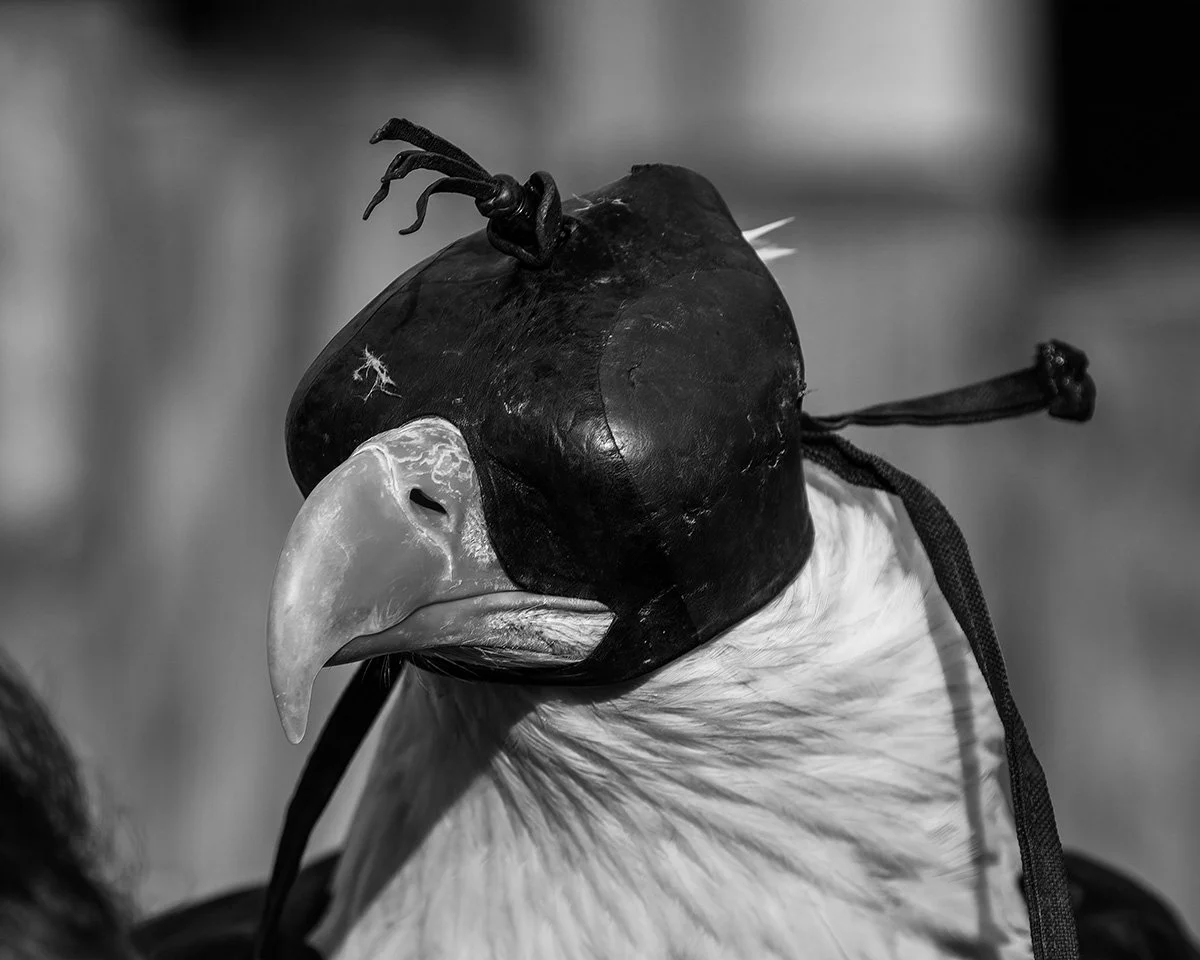
Photo from stock. Edited.
What do I do with the eagles? I hood them, I drug them, then I splay them. I tape them to the X-ray board with their chests out and their wings open, ready for the hundred-dollar bill.
On the clipboard I mark down snapped bones, shorn muscles, perforated organs. Jennifer writes in the names. She gives them names like Old Glory, Mister President, and Liberty Bond. I have different, private names for them, like McMansion, Homunculus, and Life Without Parole. I expect they have their own private names for me, too, in whatever constitutes the language of the eagles, and I expect they’re just as nasty. Sometimes I think I can see them on the screen, the names, inside the black walnut of the brain, crowded by dreams of fish and blood.
After the X-ray, I hand them off, wrapped in swaddling clothing, to the vet. What the vet does, it’s not for me to know. It wasn’t covered in the three-week certificate program. Some of them come out again stitched up like footballs. Some of them don’t come out at all. Later, when they wake up and start to thrash against the sides of the dog crate, I feed them frozen herring, popsicle fish, through the grate. No matter how much I give them, they scream for more: more fish, more freedom.
That’s how it is up here. There’s either too much of everything or too little. Too much or too little darkness. Too much or too little sunlight. Too many stars, or too few. Cabbages grow as big as bathmats and they taste like them, too. On a summer night like this one we stay out till four a.m. drinking Grizzly Beers because life is one long day and will never end. We do the same thing in the winter, but for the opposite reasons. It makes you crazy. It makes you cruel.
Take last week. We went bowling down at the Land of the Midnight Fun—Jennifer, myself, and the summer interns. They’re fresh young nothings, a couple of wet green shoots from the finest universities of the Pacific Northwest. They barely have faces yet. Just three holes, like the bowling balls. I’ve already decided on their names. One is the Spore, and the other is Mother’s Tears.
I heard Jennifer talking to them about me as I stepped to the line. She said, She kills them, you know. When they need to be put down, she’s the one they get to do it. Because she likes it.
As if to say: She likes it so much, she might do it to you.
They don’t know it, but I don’t need to kill them to kill them. I’ve already done it, by giving them names. God said to Adam, kill all the animals, and that’s exactly what he did. Later on, he came up with a name for God, and then look what happened.
But you were asking about the eagles. You probably think they’re noble beasts. Well, banish that idea. They’re not like in the movies. They don’t cry and they don’t soar. They mewl and hiss, like stray cats, and they live like them, too. They get into the dumps and eat lithium batteries and mercury thermometers. They get tangled in telephone wires and torched. They get kicked to death by moose. They eat dead things and get hatpin bones stuck in their crops. They contract diseases with embarrassing names like bumble foot and frounce. They try to steal prey from under the nose of more capable birds and get their eyes slashed out. They’re hapless American animals.
You should come see them before you leave town. There’s a window in the aviary for tourists. I’ve seen grown men stand there and salute. I’ve seen them put their hands on their hearts and start to cry. On the Fourth of July, Jennifer placed tiny flags in the bucket of salmon slurry. The eagles ate them and shat stars. Jennifer doesn’t understand them, but I do. I see them all lined up on a branch of Sitka Spruce and I think, O, my silly bruisers, my goofy goons, I’d do anything for you. But I can’t do the one thing they want, which is to let them out. I name them for myself: Apathy, Vengeance, and Malice Aforethought.
Say, have you seen a bush person yet? You can always tell a bush person by their burnished skin, like copper nuggets. There was one at the bus stop after I left the bowling alley. This one had six-and-a-half fingers, one foot, and a crutch he must have carved himself. He’d probably walked four miles on that crutch through the woods to flag down a train. You can do that here, flag down a train like it’s a bus. He had a glass eye that I think was, in actual fact, a cat’s-eye marble. He wanted to know the way to the hospital. He’d come down to give away more pieces of himself, no doubt.
I’d never name a bush person. I respect them too much. They do what everyone says they want to do but is too afraid to actually do, which is get the hell out. I include myself in that. I’d like to be a bush person, too, but I don’t have the courage.
I told him which bus to take. He told me how he used to work in search and rescue. He said he’d saved sixteen men, three women, and eight corpses from the slopes of Denali over the years. He told me a funny story about how he rescued one guy twice in the same week. The guy went back up because he’d left his cell phone up there. Then he started to tell the same story again, so I put my headphones in. That’s what always happens if you get into a conversation with a bush person—you have to sit and listen to the same story over and over, because they’ve been waiting just for you to tell it.
It’s sad, really. Words lose their grip on a guy up there, even when he’s got a wife or a dog to talk to. He gets free of words, just like he’s free of everything else. Then he comes down here and starts speaking again, like someone coming out of a coma. The words get ahold of him, and it’s so terribly sad, you just want to put him down.
Shit, forget I said that. I don’t like euthanizing eagles, or anything. That’s just something Jennifer says because I’m from Philadelphia. Jennifer lives in a compound behind the Walmart in Wasilla and thinks she’s a prospector or a pioneer.
Oh, you’ll want to hear this one. Just the other day we went out on a call near Knik River. Me, Jennifer, and Mother’s Tears—her first. Two eagles locked together. It happens. Sometimes they get their talons tangled up and they can’t or won’t let go. These two were in a ditch off the side of the road, knotted up in utmost anger, their faces too close even to bite. I named them Unstoppable Object and Immovable Force.
Mother’s Tears had the blanket and Jennifer had the net but I just leaned over and picked them up. It was easy—even a pair of them together weighs just twenty pounds. When they’re locked together like that, they don’t even notice they’re being picked up. An enemy is like a lover, you know, there’s no one else.
I held the hissing-eagle twist to her face. They writhed and beat their wings; she winced and popped her gum. That’s you and me, I said. You better not let go, or you’ll get what’s coming.
Mostly, I did it for show. To impress Mother’s Tears—one hand over her wallsocket eyes, blanket over her wallsocket mouth. And to get back at Jennifer for what she said about me at the Land of the Midnight Fun. Really, Jennifer’s all right. Even if she does ride to the Rehab Center in the winter on a snowmobile with a seatwarmer and a cupholder. On the ride back I held the eagles wrapped in the blanket and I could swear I felt their two little hearts, drumming in unison.
The truth is, I came up here to get away from that part of myself. To get away from the torn vinyl of somebody’s backseat, from the detention center, from all the unremembered bruises, so penitential, like ashes. To get away from all those faces arrayed in a circle, like a tribunal. All those faces with the same sad look and the same stupid pamphlets in everybody’s hands.
One thing I like about the eagles is they don’t have pamphlets. They don’t have sharing circles or daily affirmations. Everything they have is there on the X-rays: hollow thin bones like plastic straws, crops full of mice and trash. Their hearts are the same size as yours and mine, more or less, with the same number of chambers. They have to have big hearts to stay aloft, big hard-pumping hearts, and they wear out fast.
One look at those fragile bones, those weary hearts, and I know they need me. That’s a new feeling for me. Before I got up here, I’d been loved, I’d been longed for, I’d been lusted over, I’d been missed, I’d been an object of yearning, and in a few separate scenarios, I’d been seriously codependent. But I’d never been needed.
That’s something, you know. It’s just not everything.
Last winter I met a trucker who delivers French fries and burger buns to a truck stop in Coldfoot twice a month. I told him I wanted to go up past the Arctic Circle. The idea was strong in me that I would find what I was looking for there and nowhere else. He said: Your wish is my command.
Well, we got up there, and I got out of the truck. I walked across the Arctic Circle and back. On each side it was the same trees, the same darkness, the same snow. Well? he said. Do you feel any different?
I said I didn’t, so we went on to Coldfoot. I didn’t feel any different there, either. I wanted to go on to Deadhorse, up to the gray vast shoals of the Arctic Ocean. But he had to get back to pick up more burger buns, more French fries.
I’ll try again once the ice roads set. Jennifer knows some guys who work in the oilfields. She says they really know how to have a good time.
Well, I say. If that’s what it takes.
Christopher Lee Chilton lives and teaches in New York. His work has appeared in The Masters Review, Oyster River Pages, The Penn Review, A Public Space, South Carolina Review, SmokeLong Quarterly, and elsewhere. He can be found in most social grottoes at @grnpointer.