
“Luminosity” and Other Poems
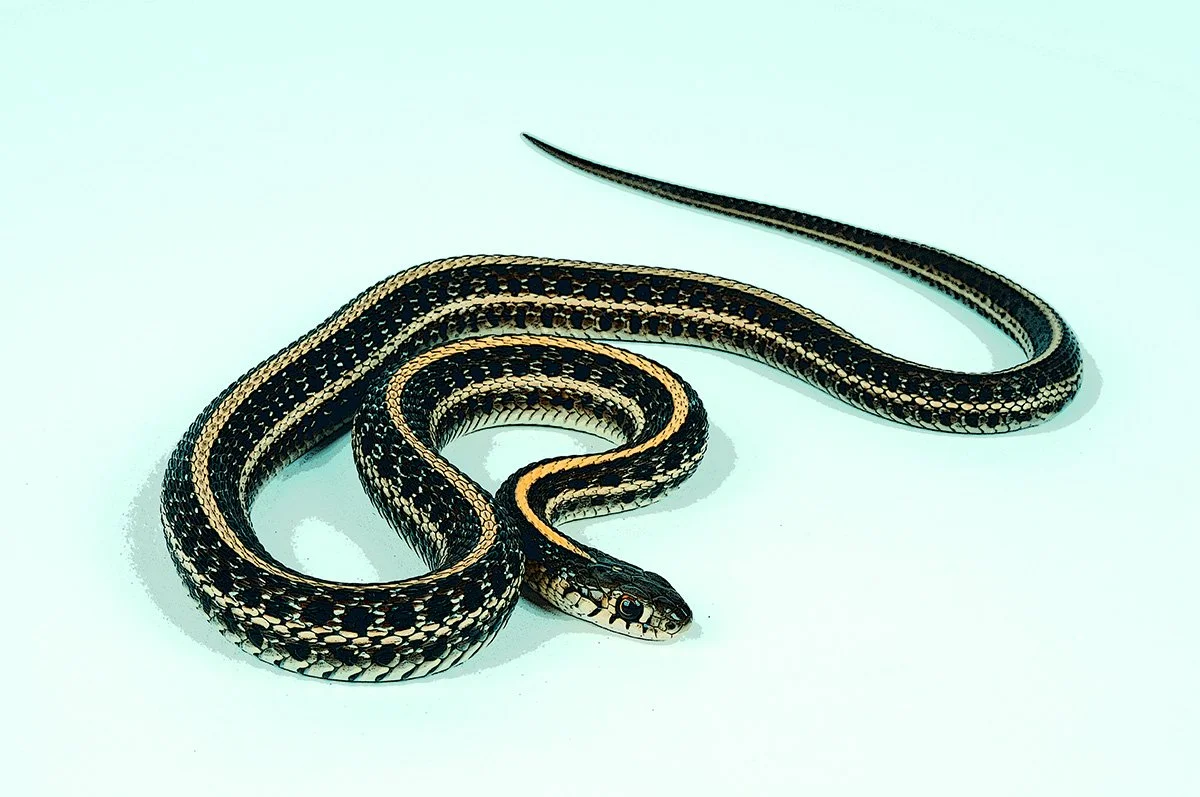
Stock image, edited.
Luminosity
I dreamed you told me of a cat
who liked to pull snakes out of holes
and then do nothing with them,
just pull them out and leave them
on the dog-scratched dirt
of your backyard.
I said I thought it would feel
satisfying, like extracting a blackhead.
You laughed, which is always
what I want, not only in dreams.
We were both drinking white wine,
which is how I knew I was dreaming.
In real life we drink beer
because it’s cheap on Tuesdays.
We call it “Today’s Special” and sing
the theme song for the show
of that name, a once-forgotten
treat when we visited the house
of someone who had cable,
a rich person, to us, back then.
You’re trying to convince me
to file for bankruptcy,
but I’m still trying to keep my failures
emotional and metaphoric.
Imagine the cat is white and the snake
harmless, a garter snake, head like
a teardrop instead of a trowel,
no armature for venom. Why not
have a backyard full of them,
writhing and smelling like hot eggs?
I Google what snakes mean in dreams;
your life shot through with toxins, or
a strong force maybe creative, maybe
destructive, mass of a dying star—
enough to explode or implode us, white dwarf
or black hole, matter, light or dark, thick as fur.
Malign
on the beige, stainful
couch. I could never clean it
perfectly, so why clean it at all?
In many instances, I’ve gambled
my laziness won’t be fatal,
the neglect will be benign,
any ships I’ve wrecked will stay
submerged. Don’t let the perfect
be the enemy of the good, someone says,
but the good never had a great
army, and the perfect, well, you know.
A Few Things Worth Noting in an Afternoon
Leaves flinch one by one in the slow rain
like the keys of a thumb piano
plunk-plunk into sound—
The road dampens
as if from below, a seep creeping
in purple splotches—
Either is like thought,
detail-detail-detail-song,
or song smearing
quarter notes whole.
I just realized I confused
thought with song,
but I do.
Though a thought sung is lost
to wind, it resounds
in the head.
Like rocks waiting
for earth’s crust to erode
to reveal themselves in a long spray
of slinky orange striations,
each like a pulp-drop of juice,
across the face of a mesa,
thoughts of a mesa warm my cheek,
sun smearing into a purple
night, the apples of my cheeks like moons
singing a coda of light
to an unbearable morning—
Another Conversation with a Pinball Machine
I see your upright backglass, yes—
But! Your ball launch, loaded with silver
moons slick as wishes, springs potential
through a kinetic lane of noise, thwick
and clang of spin and bump chime through
the arcade’s artificial night, lit with
flippers’ bell-flashes, red and yellow
syncopation, all-out chaos
cabinet-trapped—
Your neighbors roar
like dinosaurs or sing like mounted
fish, or moan as if in ecstasy to be held
aloft by the Creature
from the Black Lagoon.
You sound the same, catching
quarters with those light-up sets
of boobs barely dressed
in silk slips—
any sense
of control a semblance—
I press your buttons, aim and miss,
aim and miss, and play the ball until
your luster drains down the trough.
Bloom / Storm / Lush
Organs grow behind a cage
of bone. Leg muscles twitch.
Like my dreams, they want me
to run, a fungal thrum growing
down a darkening street
of spine, line a finger traces
up the gutter of my back.
Progeny of the protected, left
to twirl the strands of life around
matter’s index finger, our cells
sloughed off as dust
until all that’s left is left
to propagate itself,
like squirrels stirring the plum
blossoms off the branches
aren’t the reason the trees bloom.
Alike, we strip our color
petal by petal until the grass
is carpeted in dead brown curls
and we’re left nubbins on the end
of a stick, pencil shavings, gray as the end
of time, as a Greek statue when the paint’s
worn off, and misunderstood alike
as an enduring standard of beauty
instead of the bland that was to be
covered, entropy mistaken as aesthetic.
Organs grew because there was already
bone, the one that curves across the sky.
Barbara Duffey is the author of three poetry collections, including Simple Machines (2016), which won the 2015 Washington Prize, and A Wasp in a Fig's Womb, forthcoming in 2027. She has received fellowships from the NEA, the Jentel Foundation, and the South Dakota Arts Council. A professor of English at Dakota Wesleyan University, she lives in Mitchell, SD.